It seems like the sugar high that comes with Halloween has barely worn off, and now we're talking about Thanksgiving. Should we go here, or should we go there? Have people over, or contribute to someone else's big day? Ham or turkey? Totally from scratch side dishes, or partially homemade?
Last time on this blog, I shared my favorite pumpkin spice bread recipe. If you missed it, you can check it out here. I'm not sure if I'll make that, or pumpkin pie with homemade whipped cream. Yum!
Everything's Better with Whipped Cream
Of course, it would be easier to get everything ready if I could just make some of the items a day or so ahead of time. There's just one (or should I say two!) problem(s) with that! You see, I have teenagers at home. Well, actually I have one teenage girl, and an almost teenage boy, but since the boy eats as much as a grown construction worker (or a black hole!), I count them both as teenagers. ;)
My Son Eats Like One of These!
Those of you with teenage boys in the house know... it's nearly impossible to keep delicious food in the kitchen. It tends to disappear within hours, if not minutes! Even the plain stuff goes missing. The other night I was going to make tacos, but all the tortillas were gone. When I confronted my son, he admitted he had eaten them, because they were "delicious." Mind you, we have plenty of bread in the house, but I guess it's easier to sneak a bag of tortillas than it is to hide a loaf of bread!
Luckily, I do have a couple of Thanksgiving items ready for my classroom, and these are things my son can't "disappear!"
The first includes this set of 2-3 Digit Multiplication Math Center Task Cards. They will provide my students with the multiplication practice they need, but allow them to do so independently. They also have adorable Fall and Thanksgiving graphics, which helps keep my students interested.
I also have a new Common Core inspired ELA and Math Print and Go Pack to keep my kiddos busy on standards-based, yet fun classwork. Since about 1/3 of my students will be gone that week, I don't want to introduce new material, but I need to have them practice the material I've already taught. I also need work to send with students who will be absent that week.
Since this pack includes enough selections for Reading Comprehension (which I'll also use to have them develop Fluency), Writing, Vocabulary, and Math to last an entire week, the only things I'll have to plan will be when to pull my small groups. The pack even includes some fun puzzles for early finishers, as well as a Fraction Bingo Game for the whole class to play. (Can you say, "Parent Volunteer" anyone?)
I might even have time to catch up on some administrative tasks (a.k.a. paperwork), so that I don't have to take anything home over the break.
Finally, when I think they just need to get out of their seats for awhile and work off some of that pre-holiday energy, I'll use this set of Thanksgiving-Themed Class-Building Cards.
Students love these, and they help build classroom rapport. Kids get to talk to one another about their Thanksgiving traditions, which builds cultural sensitivity and awareness. Full directions are included.
Of course, after Thanksgiving comes Christmas, and then New Year's. Are you ready?
As promised, I'm back with an Interactive Notebook template for comparing and contrasting early North American peoples. I've also included an anchor chart and a sample summary for the lesson.
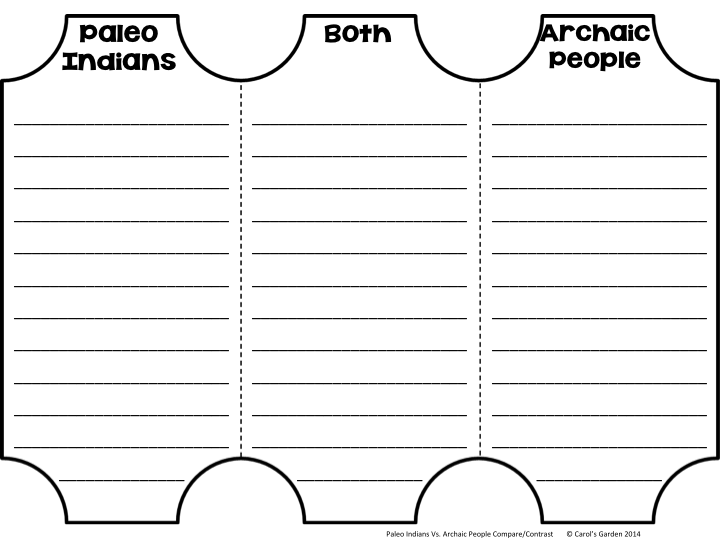
Here's the INB template I designed for this lesson. I would have students cut this out during morning announcements, then store it in the envelopes in the back of their notebooks until time for the writing lesson. Since this is a cross-curricular skill lesson, I would take time during both the writing block and social studies as needed to finish.
The copy I give to students would actually be blank where I currently have clipart showing people of the time. I want them to use their own illustrations, but this is an accommodation you could use for absent or struggling students. I designed this starting with a completely blank template I downloaded from Tangstar Science here.
I would have my own copy of the blank template projected on the Interactive Whiteboard, so that we could complete this as a class. This is what the inside would look like.
As a class, we would come up with descriptive items to fill out the chart. Differences go under the specific people, while similarities go under "Both." For instance, Paleo Indians lived when the Earth was much colder, while Archaic people enjoyed a climate and environment much like today's. However, both were hunter-gatherers. However, the Paleo Indians used sticks and spears to hunt large animals, while the Archaic people developed the atlatl to enable them to hunt smaller animals with greater accuracy. Here's a video from PBS showing the design and use of the atlatl.
We would talk about the use of signal words to show when we are comparing two like items, or contrasting two items which are not alike. I would encourage students to come up with these signal words to fill the chart. (If students had difficulty with this, I would have them pull out a previous comparison/contrast article from a different assignment and have them search for the transition words.) This is what I would expect the chart to look like by the time we finished creating it as a class.
Once the anchor chart and Paleo vs. Archaic People foldable graphic organizer were complete, we could proceed to the compare/contrast summary paragraphs. Of course, your own curriculum probably differs from mine, but here is a sample of what I would be working on with my students.
I love typing this sort of thing on the computer while students watch, because it shows the ease of editing from a computer program. Fourth graders need encouragement to type on the computer, and this is one way I try to encourage them. I also think it's a good idea to go back as a class and highlight the comparison/contrast transition words. It's an effective way to remind students to look for these words in their own writing later.
Once students have completed these steps together as a class, I would have them complete similar activities for later Native American groups. My struggling students would probably continue to need small group support to be successful at this, while my high groups would be able to fly on their own. By far the largest group of students would need modest support, and we would continue to complete more of these types of assignments as the weeks progress.
As a quick response, I would ask students to compare and contrast two items of their own, such as two types of animals, or two sports teams, and write a brief paragraph about it in their journals.
I hope you've enjoyed reading about using Interactive Notebooks for comparison/contrast lessons. If you are interested in purchasing this lesson, check out my store here. Thanks for stopping by! Please leave some feedback below!
I'm home with a sick child (and a sick me) the last few days. It's amazing how dull my brain is when I'm sick. I've been wanting to get this post finished for almost a week. I finally decided that it was never going to be "perfect" and I needed to just let it go, so here it is.
Getting an Interactive Notebook lesson ready for new curriculum is kinda scary, so I wanted to be prepared. One of the literature links in our new social studies curriculum involves the use of pourquoi stories. Some of the suggested readings were familiar to me, while others were not.
Pourquoi Stories Explain the Natural World
I decided to start with the definition of pourquoi stories, as well as some background vocabulary for the students. Pourquoi means "why" in French, which helps explain the meaning of pourquoi. These stories attempt to explain why certain things are the way they are in the natural world.
This pocket would be glued in the Interactive Notebook, with each unit vocabulary word and definition as an item to be placed inside. (That way students could pull them out to study.)
Fortunately, I found this cool video reading of one of the stories, Grandmother Spider Brings (Steals) the Sun. It's read by a member of the Navajo nation, (although my teacher's guide says it is a Cherokee story) and I love that when it comes time for grandmother spider to sing a song, this reader is able to lend her distinctive voice to the task.
The video is ten minutes long, so I decided I would show this right after lunch, then have students fill out the first part of the foldable for their Interactive Notebooks using this story. Here's what the blank page would look like before starting the process.
Pourquoi tales use animal characters to explain why something occurs in the natural world, as well as give the listener guides for correct behavior. We needed to find out what the story was trying to explain. After some class discussion, here's the result I was hoping for: where did the sun, light, and fire come from? Why do opossums have "rat tails?" Why do buzzards have bare heads? and How did the people learn to make pottery?
Next, we needed to find out what lessons for correct behavior the story was trying to teach. Each of the animals who tries to get a piece of the sun has special gifts or abilities. Even after repeated failure the animals do not give up. Even the smallest or most frail among us has the power to do good. If we all work together, we can achieve what may seem impossible at first.
I figured this would be plenty for one day's instruction. I resolved to make finishing the foldable part of centers for the week.
The next pourquoi tale would be one of my all-time favorites. (Since this story does not originate among the tribes of the Southeast, I would not use it in my graphic organizer, but I do want to expose students to various native cultures. Those of you who teach in other states might find this book meets the standards there.)
Raven: a Trickster Tale from the Pacific Northwest tells the story of the Raven, who feels sorry for the people who must live in darkness, so he travels to the house of the Sky Chief, where he steals the sun. He places the sun in the sky, so that the people may have warmth and light.
This book is beautifully illustrated, showing the foggy coast, mountains, and native dress and housing of the people of the Pacific Northwest. It also makes a terrific read aloud for the whole class. Here's my favorite illustration, which shows the Raven stealing the sun from the house of the Sky Chief:
In addition to explaining how the sun and light came to light the world, this story also explains why the Raven says, "Caw! Caw!" It tells why the Native Americans of the Pacific Northwest always feed the bird (which I did not know before I first read the story), because they are thanking him for delivering light to the world.
The story teaches that through perseverance even a small creature can accomplish mighty acts. Helping others is noble.
The next pourquoi tale for this lesson would be How the Rabbit Stole the Fire. This story is associated with the Creek tribe of the Southeast.
Just as the title suggests, this story explains how the people received warmth and light. It explains why some animals look the way they do. It also explains why the sun rises in the sky every day.
I like how all three of these stories tell the same basic tale, but in different ways. This is evidence that the tribes had contact with each other over time. However, since the raven story does not meet the standards for my state, I needed one more Native American trickster tale. This one is from the Choctaw tribe, also from the Southeast. According to the book's description, all the clothing worn by the animals in the story is based on authentic, traditional clothing of the Choctaw people, so this book was especially interesting to me.
"Chukfi Rabbit is lay-zeee!" is the idea behind the story. The other animals want to build a house, which sounds like far too much work for lazy Chukfi. However, when Chukfi finds out that the animals plan to share a feast including some delicious butter when they have finished their labors, the lazy rabbit devises a plan to skip the work, yet still get the reward of the yummy butter. Of course, he ends up with a huge bellyache!
This story teaches that working together helps the community. Together, we can accomplish great things. Beware of laziness and greed.
Here are examples for each page. I used different colored ink for each story. I also think it's important for students to sketch out a visual for each story. This becomes important as an example for when they design their own stories. Simple thumbnails are fine for this. I've included clipart on my example just to give you an idea of what it can look like.
Example for Front Page
Example for Inside Left Page
Example for Inside Right
Of course, you may need to use different stories in order to meet the standards in your state. There are pourquoi stories from around the world, with many different tales to match your needs.
Finally, students will need to write their own pourquoi stories. To help them get started, I've designed a brainstorming graphic organizer. On it, students will need to write down some ideas of things from the natural world which they could explain in a pourquoi story.
Since many pourquoi stories are also trickster tales, I would encourage students to think of ways the animals could be tricked, or trick others, to accomplish their goals. These graphic organizers will be used to plan students' own pourquoi stories during the writing block. Students will be asked to come up with about six different ideas for natural world items to explain, along with the animals they would use and how the items would be explained. For their final stories they would choose from these to get started.
I hope you've enjoyed reading about pourquoi stories and the Interactive Notebook! If you are interested in purchasing this lesson, you can find it in my TpT shop here.
If you're not following me yet, just click on the Bloglovin icon at the upper right of the screen, or on Google Connect, in order to make sure you get all my posts on implementing Interactive Notebooks for social studies. Please leave a comment if this post has been at all interesting or helpful to you! Thanks! Have a wonderful week!